Build It Right. Start With the Foundation.
Panda Voiceover · Relational Database Architecture Redesign
The original Panda Voiceover database supported the platform’s existing operations, but its structure had become a limitation as our needs evolved. Information about talent, voice characteristics, pricing, availability, and other services wasn’t organized in a way that could reliably support advanced search, machine learning, or future platform growth.
Rather than starting from scratch, we examined the existing data, preserved what was useful, and applied relational data modeling and database normalization principles to reorganize the architecture. By separating information into clearer entities and defining relationships between them, we aimed to reduce data redundancy, improve consistency, and establish a foundation for talent onboarding, natural-language discovery, and future product capabilities.
Database Normalization · Relational Data Modeling · Data Architecture · Schema Design
01 / THE ORIGINAL STRUCTURE
When the Platform Outgrew Its Database
The original data structure supported Panda Voiceover’s day-to-day operations, but it wasn’t designed for the capabilities we wanted to introduce next.
As the platform evolved, we needed a more consistent way to organize talent profiles, voice characteristics, pricing, and other information. The existing structure made it difficult to establish clear relationships between data and prepare it for more advanced filtering, natural-language search, and machine-learning workflows.
The question became: How could we preserve the information we already had while rebuilding the structure around what the platform needed next?
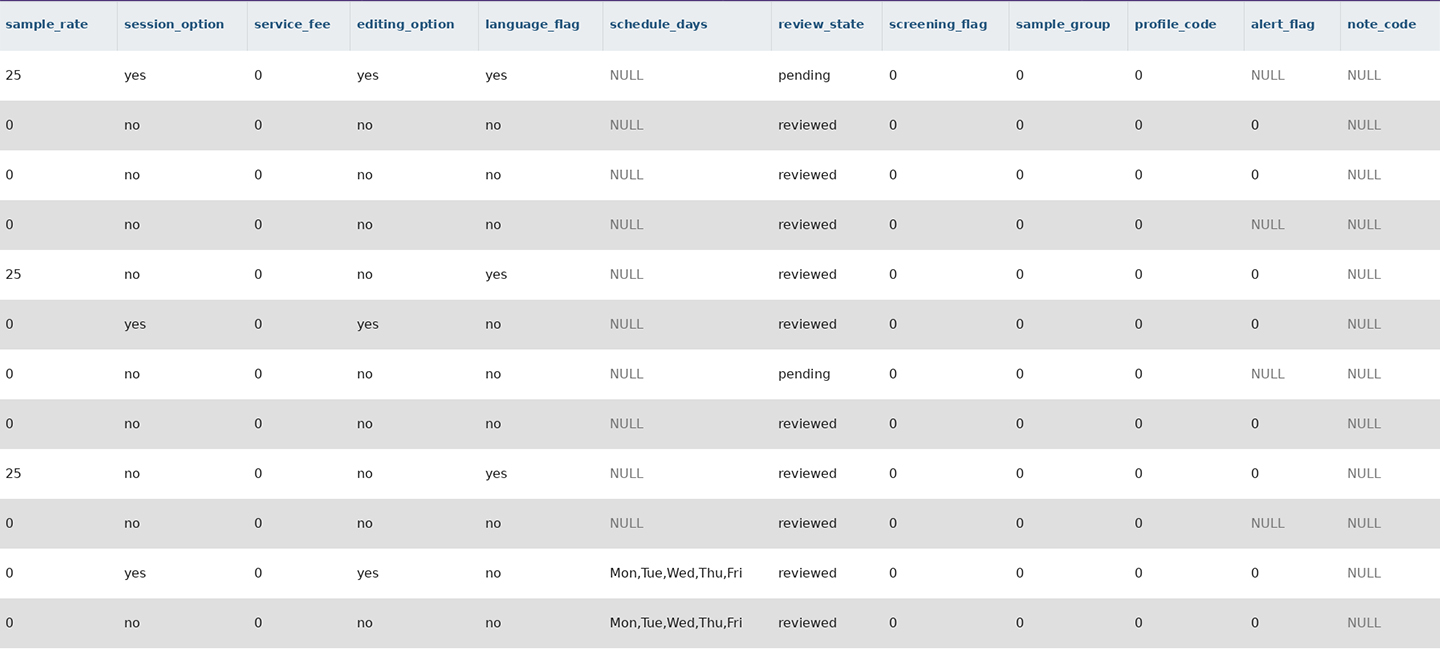
*Illustrative database excerpt. Data has been anonymized or modified to protect sensitive information.
02 / THE CHALLENGE
The Data Was There. The Structure Wasn’t.
The challenge wasn’t a lack of information. Panda Voiceover already had valuable data about its talent, services, and operations. The problem was how that information was organized and connected.
Data Organization
Talent details, voice characteristics, pricing, availability, and operational fields were stored within oversized records. This made the data harder to maintain, update, and reuse consistently.
Relational Structure
Different types of information needed clearer separation and relationships. Without a more structured relational model, the platform was limited in how effectively it could connect and retrieve data across different workflows.
Future Capabilities
Natural-language talent discovery and ML-assisted screening required data that could be organized, queried, and connected reliably. The existing architecture wasn’t prepared to support those requirements as the platform evolved.
The design opportunity was to preserve the value of the existing data while creating a normalized, relational foundation for the next generation of platform features.
03 / THE RESTRUCTURING APPROACH
Preserve the Data. Rethink the Structure.
Rebuilding the database didn’t mean discarding everything that already existed. We started by reviewing the original records, identifying information worth preserving, and examining how different types of data were organized.
Using database normalization principles, we restructured the schema around more clearly defined entities and relationships. Rather than keeping unrelated information together in oversized records, the approach separated data according to its purpose and established a more consistent relational model.
The objective wasn’t simply to reorganize tables. It was to create an architecture that could support more reliable data management and the platform’s evolving requirements.
Preserve what matters. Separate what belongs apart. Connect what needs to work together.
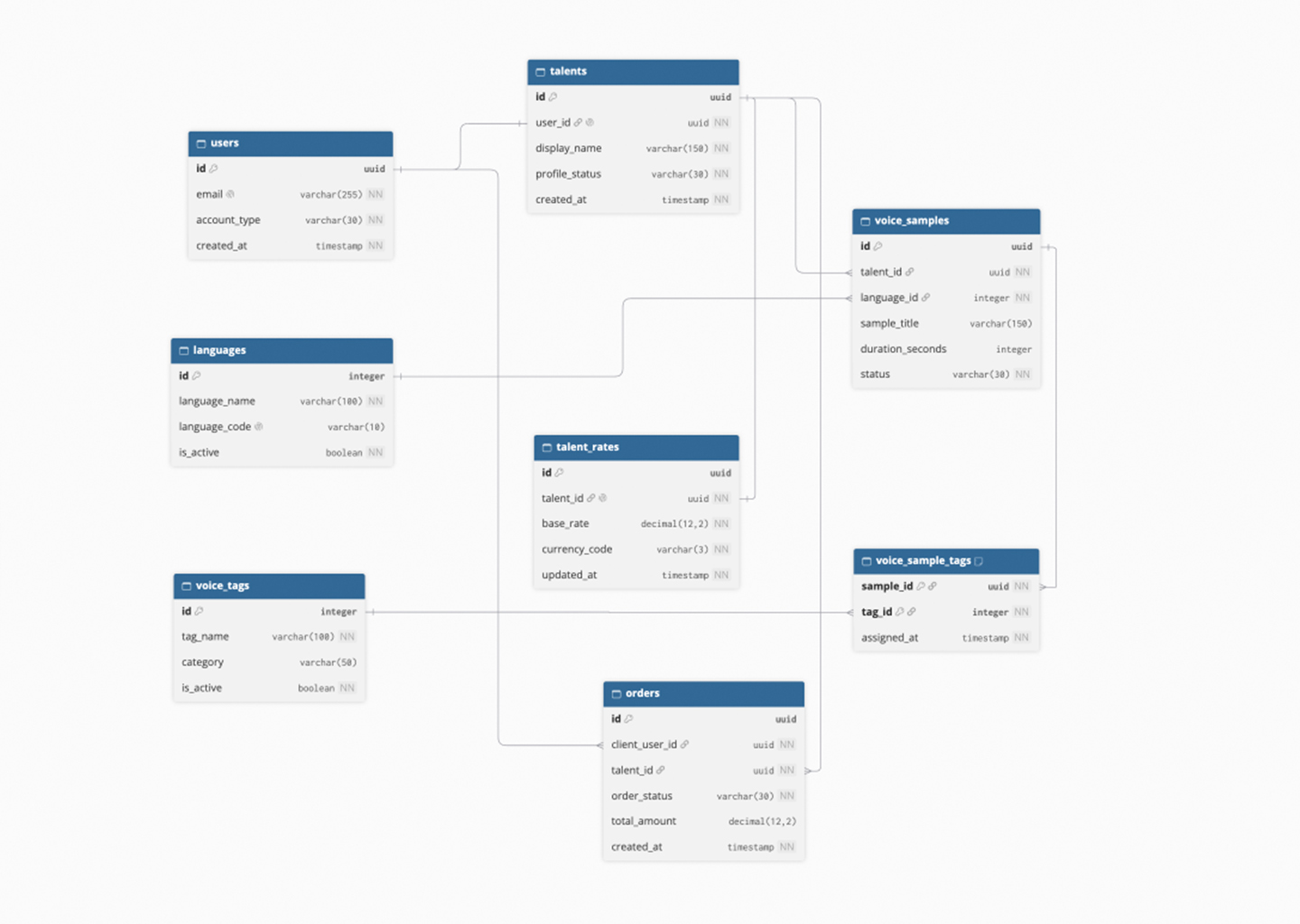
*Illustrative entity-relationship diagram showing a simplified portion of the redesigned architecture. Sensitive and proprietary details have been omitted or modified for presentation.
The redesigned schema organizes platform data across 21 related tables, using defined relationships to separate responsibilities, reduce unnecessary duplication, and support more consistent data management.
04 / CONNECTING THE PLATFORM
One Foundation. Multiple Possibilities.
The database redesign was more than a technical restructuring exercise. It established the underlying architecture needed to support the platform’s evolving product experience.
By organizing talent profiles, voice characteristics, samples, pricing, and operational information into related entities, the architecture was designed to support more flexible talent discovery, ML-assisted screening, and future management tools.
These capabilities were connected by a common requirement: structured, consistent, and accessible data.
The goal wasn’t just to build a better database. It was to build a foundation for everything that came next.